
Imagine transforming ordinary spaces into living art that whispers stories of the past while solving modern challenges. For over 2,000 years, China’s landscape masters have shaped environments where every stone and stream carries purpose. Ming dynasty expert Ji Cheng revealed this philosophy in The Craft of Gardens, showing how nature and architecture dance together.
These spaces weren’t just pretty backdrops. They served as extensions of homes – places for reflection, celebration, and connection. Moon-viewing platforms and winding pathways did more than fill space. They created journeys for the mind and spirit.
Today’s urban planners and homeowners are rediscovering these ideas. You’ll see rooftop terraces using scholar’s rocks as focal points. Courtyards blend bamboo screens with glass walls. The magic lies in balancing symbolism with practicality – water features cool summer air while representing life’s flow.
This approach helps solve 21st-century needs. Compact city homes gain depth through layered vistas. Office complexes reduce stress with contemplative corners. By understanding the original intent behind these design elements, you can adapt their essence for any project.
Introduction: The Fusion of Past and Present in Chinese Garden Design
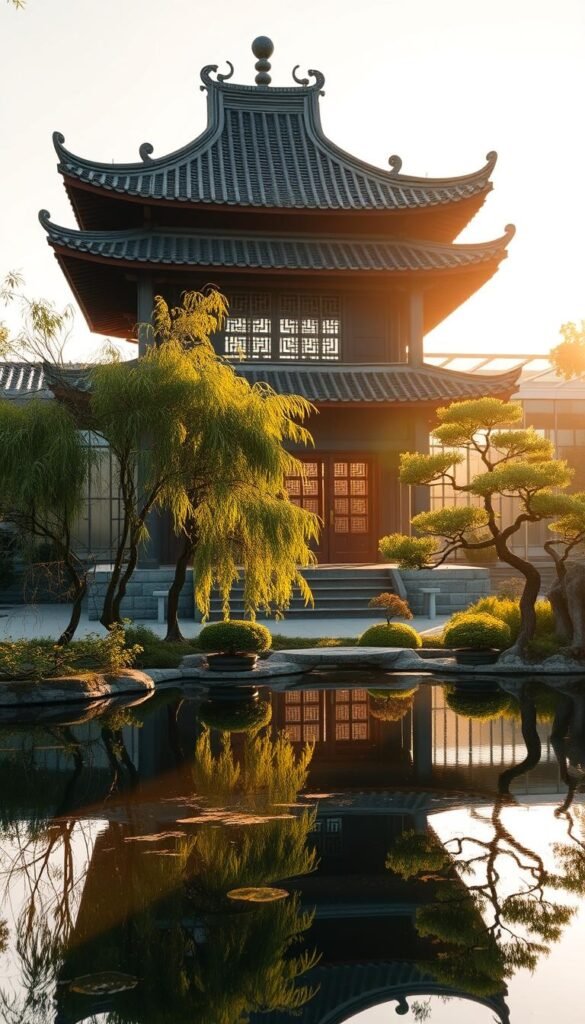
What happens when centuries-old green spaces meet modern cities? The answer reshapes how we experience urban life. Once reserved for emperors, places like Beijing’s Beihai Park now host concerts and morning tai chi sessions. In Suzhou, the Humble Administrator’s Garden welcomes 5 million visitors annually – a far cry from its scholarly roots.
“We’re not copying history – we’re conversing with it,” says Shanghai landscape architect Mei Lin. “Modern needs determine which traditions stay relevant.”
Three key transformations show this evolution:
| Garden Name | Historical Use | Modern Function |
|---|---|---|
| Beihai Park | Imperial retreat | Public event space |
| Humble Administrator’s Garden | Scholar’s sanctuary | UNESCO World Heritage Site |
| Slender West Lake | Private water garden | Urban ecological model |
Your local park might already use these principles. Curved walkways that once symbolized life’s unpredictability now manage crowd flow. Moon gates framing specific views help photographers and Instagrammers alike. The real magic happens when old symbols gain new purposes.
Design teams across California are testing these ideas. A San Francisco rooftop garden uses zigzag bridges to create wheelchair-accessible slopes. Phoenix developers install perforated walls that cast cooling shadows – modern takes on traditional lattice screens. As one architect notes: “The best solutions honor history without being trapped by it.”
Exploring the Historical Legacy of Chinese Gardens
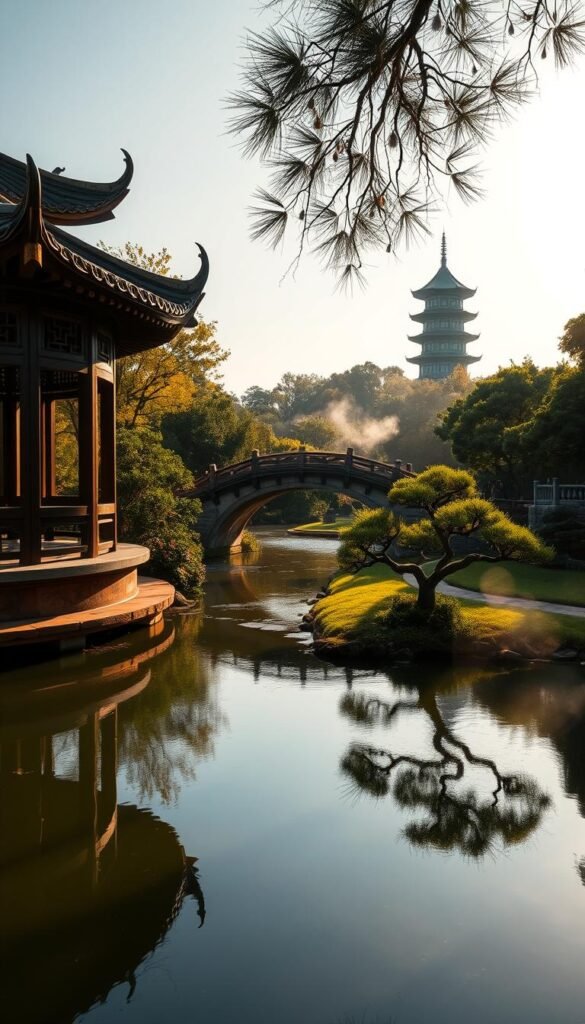
Picture walking through spaces where rulers once contemplated life’s mysteries. For over two millennia, these cultivated landscapes have shaped how we interact with nature. Early records from the Qin and Han dynasties reveal raised pavilions designed for viewing rare plants and sculpted terrain.
Masters treated garden creation like composing poetry. They studied revered layouts as carefully as calligraphers copied ancient scripts. Emperor Qianlong took this further – he dispatched artists to sketch southern estates, then recreated them stone-for-stone in his northern palace.
Three principles defined these spaces:
- Symbolic storytelling: Rocks represented mountains, ponds mirrored seas
- Balanced contrasts: Open courtyards paired with intimate nooks
- Regional adaptation: Southern designs favored water features, northern versions used hardy pines
You’ll notice how cleverly these spaces hide human effort. Winding paths feel spontaneous, though every turn was planned. What seems wild actually follows strict composition rules perfected over centuries.
Modern creators draw from this rich legacy. The practice of modifying classic layouts – not copying them outright – sparks fresh ideas. As one landscape historian notes: “True homage means understanding why choices were made, not just repeating what worked before.”
Understanding Traditional Chinese Garden Elements
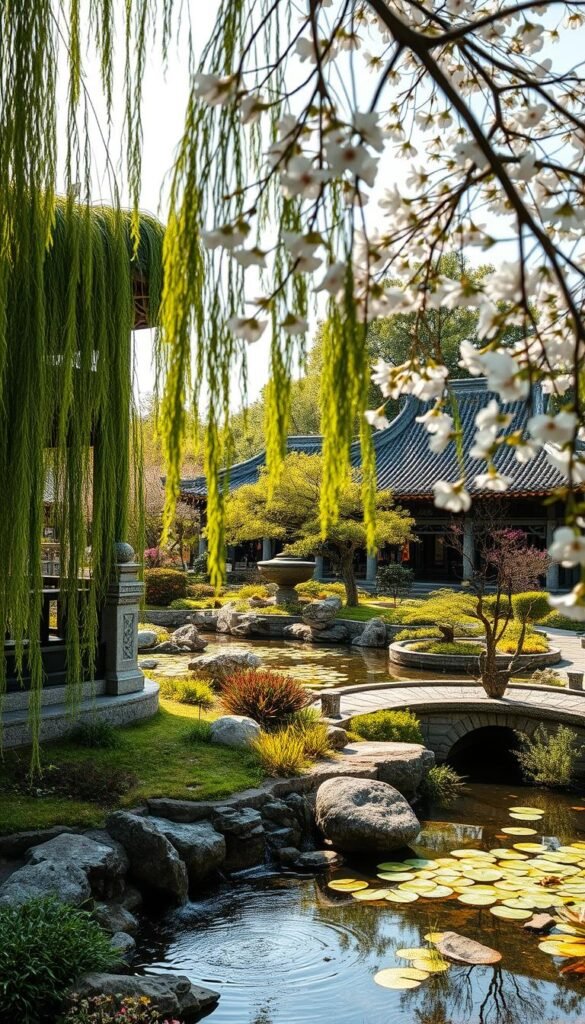
Have you ever wondered how ancient gardens create such timeless beauty? The secret lies in their carefully chosen elements that speak through shapes and materials. Moon Gates aren’t just circular openings – they’re living picture frames that direct your gaze to blooming cherry trees or weathered stones. Zig-zag bridges do more than cross ponds – they slow your pace to appreciate rippling water.
Your material choices become storytellers when working with these features. Consider the four classic rock types that shape miniature landscapes:
| Rock Type | Source | Characteristics | Symbolism |
|---|---|---|---|
| Lake Stones | Lake Tai | Wave-carved limestone | Eternal change |
| Yellow Stones | Mountains | Smooth sandstone | Stability |
| Blue Stones | Quarries | Cross-weaved patterns | Harmony |
| Bamboo Shoot | Riverbeds | Slender vertical lines | Growth |
Bamboo isn’t just a plant – its rustling leaves whisper ancient poetry. Designers position these trees to catch morning light or cast summer shade. As landscape artist Wu Fan explains: “Every stem serves three purposes: beauty, meaning, and function.”
You’ll notice how pathways guide discovery. A sudden turn might reveal a hidden bench carved from lake stone. Overhead, lattice screens paint dancing shadows that change with the hour. These features work together like instruments in an orchestra – each playing its part to create immersive nature experiences.
Modern spaces gain depth when using these elements. A moon gate becomes a portal between office areas. Bamboo clusters soften concrete walls while cleaning urban air. By mastering this visual language, your garden designs can whisper secrets from centuries past while solving today’s needs.
Integrate Heritage and Modernity with Chinese Garden Design Elements
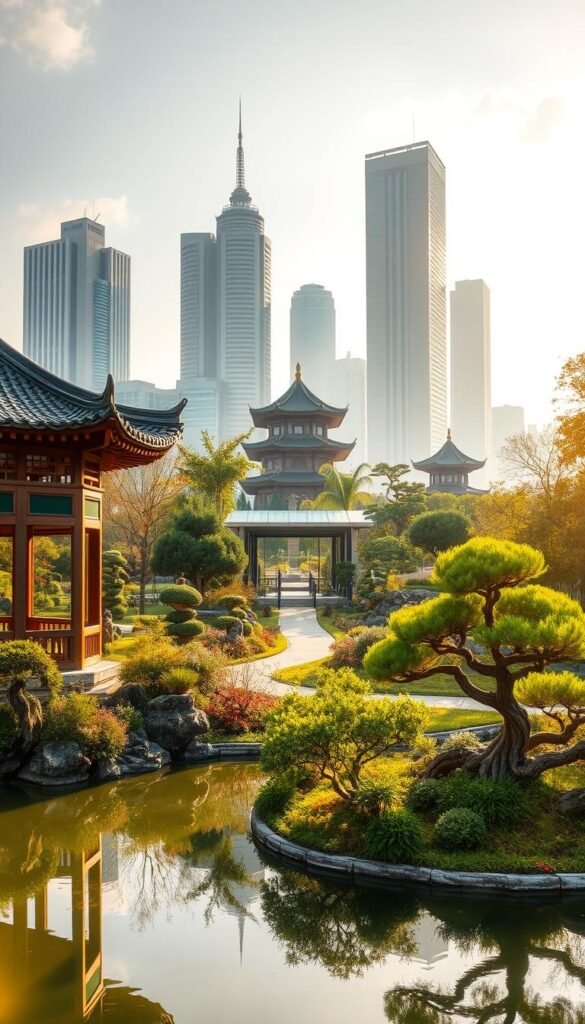
How do ancient traditions shape tomorrow’s cities? UNESCO research shows cultural preservation boosts sustainable development by 37% in urban areas. This approach transforms concrete jungles into living narratives where history meets progress.
Your projects can achieve this balance through strategic adaptations. Consider repurposing pavilions as shaded coworking spaces or using rockeries as natural sound barriers. A Seattle park recently converted Ming-style corridors into solar-powered charging stations – proof that cultural depth enhances functionality.
Three principles guide successful integration:
- Symbolic reinterpretation (water features managing storm runoff)
- Material innovation (laser-cut screens mimicking lattice patterns)
- Community-driven storytelling (local artists crafting tile mosaics)
Chicago’s Jade Wind project demonstrates this perfectly. Traditional moon gates frame city skyline views while serving as wind buffers. “We’re not building museums,” explains lead architect Rosa Chen. “Our landscapes should whisper history while shouting innovation.“
Your sustainable strategies gain new dimensions through these methods. Ancient water circulation systems now cool parking structures naturally. Native plant arrangements based on imperial gardens reduce irrigation needs by 40%. Each choice becomes a dialogue between ancestral wisdom and contemporary needs.
The magic happens when you treat traditions as living elements rather than relics. A Phoenix housing complex uses modular walls that recreate Scholar’s Rock formations. Residents rearrange them seasonally – blending personal expression with cultural continuity. This approach creates spaces that honor the past while writing new stories.
Landscape Design Insights: From Classical to Contemporary
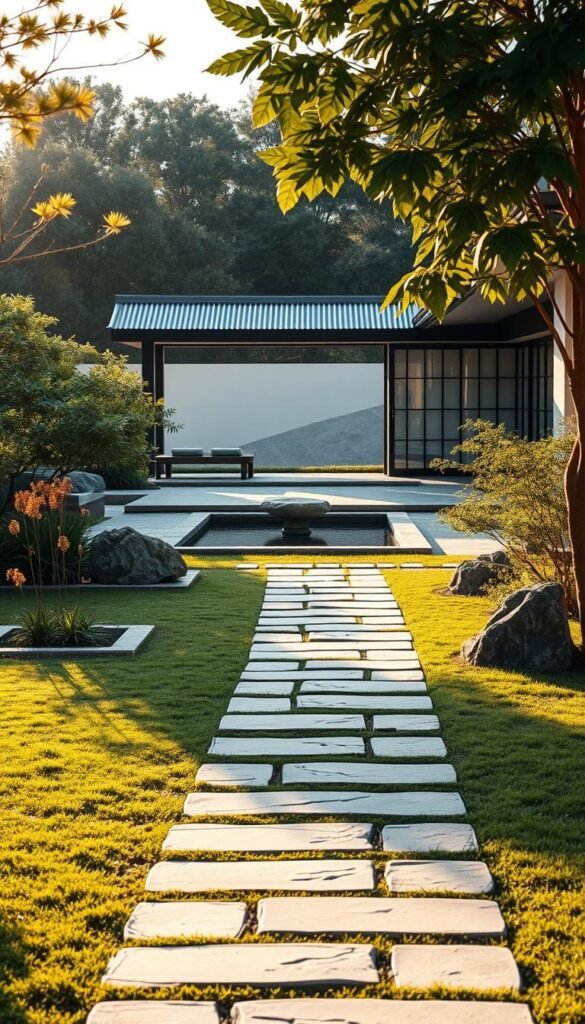
What if yesterday’s design wisdom could solve tomorrow’s urban puzzles? Wang Shu’s Ningbo Museum answers this challenge. Its walls use recycled tiles arranged like mountain ranges – a modern echo of classical landscape principles. This Pritzker winner proves tradition thrives when reinterpreted, not replicated.
Three pioneers show how personal roots shape global design:
| Architect | Method | Key Project |
|---|---|---|
| Wang Shu | Material storytelling | Ningbo History Museum |
| I.M. Pei | Spatial poetry | Suzhou Museum |
| Wang Da-Hong | Light manipulation | Yangmingshan Guesthouse |
You’ll notice how childhood memories fuel innovation. Pei’s Suzhou Museum water courtyards mirror his ancestral landscape experiences. “We don’t copy ponds,” he once noted. “We capture their ability to make time stand still.“
Your projects gain depth through layered understanding. Study how lattice patterns became sun-shading systems in Dubai. Discover why zigzag paths work better than straight walks in hospitals. These insights emerge from cultural fluency, not decoration.
Urban spaces now benefit most. A Miami high-rise uses rockery-inspired facades to reduce heat gain. Seattle’s park system applies garden-making concepts to manage stormwater. When you treat traditions as living ideas, every project becomes a dialogue across centuries.
Urban Landscape and Sustainable Design Practices
Cities are transforming concrete expanses into climate-smart ecosystems using timeless principles. The European Landscape Convention champions this shift, urging planners to weave ecological solutions into urban frameworks. Traditional methods now fuel modern landscape design that cools streets, manages storms, and nurtures biodiversity.
Implementing Green Infrastructure
Your city projects can mirror ancient water management systems. Constructed wetlands inspired by classical ponds filter runoff while creating habitats. Permeable pathways reduce heat islands like traditional gravel courtyards once did.
| Traditional Element | Modern Application | Benefit |
|---|---|---|
| Rock-lined ponds | Stormwater basins | 30% faster drainage |
| Winding walkways | Pedestrian cooling corridors | 2°F temperature drop |
| Bamboo groves | Noise buffer plantings | 50% sound reduction |
Cultural Sustainability in Urban Projects
The Florence Charter guides your approach to meaningful spaces. A Phoenix city initiative trains teens in ancient pruning techniques while maintaining parks. These projects become living classrooms where heritage shapes tomorrow’s communities.
Seattle’s Jade District shows how this works. Rain gardens styled after Chinese water features handle 60% of street runoff. “We’re growing both plants and cultural pride,” says lead designer Marco Li. Every element serves dual purposes – practical and poetic.
Harmonizing Chinese Garden Architecture with Modern City Planning
Urban areas often struggle to balance growth with cultural identity. Feng Jizhong cracked this code at Shanghai’s Fangta Yuan park. His team transformed a 1,000-year-old pagoda site into a vibrant public space using elevation shifts and native plants. They proved historical architecture could anchor modern planning without feeling like a museum exhibit.
Feng’s approach reveals three smart strategies for today’s city projects:
| Challenge | Traditional Solution | Modern Adaptation |
|---|---|---|
| Preserving relics | Isolate structures | Create viewing corridors |
| Managing crowds | Winding paths | Multi-level walkways |
| Blending eras | Replica buildings | Material contrasts |
“True harmony happens when old and new share the same breath,” Feng noted. His team used weathered stone near glass pavilions, letting materials tell time’s story. You can apply this thinking to street design by pairing historic lampposts with solar panels.
Current planning schemes gain depth through spatial layering. Try these techniques:
- Use bamboo screens as living walls between bike lanes
- Convert covered walkways into shaded charging stations
- Design plazas with hidden drainage inspired by pond systems
Portland’s Lan Su District shows this works. Their mixed-use complex uses moon gate motifs in pedestrian bridges. The result? A city block that feels timeless yet functions for 21st-century needs. Your projects can achieve similar balance by treating historical architecture as a partner, not a prop.
Embracing Heritage in Modern Design and Construction
Master builders once spent years perfecting the placement of a single stone. Today’s teams blend this meticulous care with cutting-edge construction technologies. Imagine using 3D scans to match natural rocks with digital models, preserving craft traditions while accelerating timelines.
Adapting Traditional Techniques
Rockery artisans now collaborate with engineers to meet seismic codes. They stack stones using hidden steel frames that mimic ancient dry-stack methods. Your projects gain structural integrity while keeping the organic beauty of irregular formations.
Innovative Material Applications
Bamboo meets concrete in surprising ways. Researchers developed composite panels that combine reed textures with fire resistance. These building solutions honor material heritage while exceeding modern safety standards.
| Traditional Material | Modern Adaptation | Benefit |
|---|---|---|
| Lake Stones | 3D-printed replicas | Weight reduction |
| Hand-carved lattice | Laser-cut steel | Weather resistance |
| Clay tiles | Recycled composites | Carbon reduction |
“We’re not replacing traditions – we’re giving them new tools,” says contractor Lena Wu. Her team restored a Ming-era wall using original mortar recipes enhanced with non-toxic stabilizers. Your design approach can achieve similar harmony through thoughtful experimentation.
Infusing Artistry: The Role of Visual and Spatial Aesthetics
Ever notice how some spaces feel alive with hidden stories? Traditional Chinese gardens act as three-dimensional poetry, where every curve and contour whispers meaning. Moon gates frame views like living paintings, while winding paths invite curiosity. Your design projects gain depth when you treat spaces as narrative tools rather than empty canvases.
Mastering spatial flow transforms ordinary layouts into emotional journeys. Think of how zigzag bridges slow movement, letting visitors savor water reflections. You can apply this principle by creating sequences of discovery – a hidden bench here, a framed vista there. As one garden maker noted: “Paths should tease the eye, not race to destinations.”
Three techniques elevate aesthetic impact:
- Layered symbolism: Use rocks as mountain metaphors, ponds as liquid mirrors
- Controlled revelation: Position screens to partially conceal features
- Dynamic balance: Pair wild plantings with geometric structures
Your view compositions become powerful storytelling tools. A strategically placed scholar’s stone might anchor a seating area while symbolizing resilience. Modern parks adopt this approach – Chicago’s Ping Tom Memorial Park uses willows to soften skyline views, blending nature with urban grit.
True artistry emerges when form serves multiple purposes. Bamboo groves filter noise while casting dancing shadows. Dry stone arrangements direct foot traffic and manage rainwater. By studying these time-tested methods, your design work becomes both functional and philosophically rich.
Innovative Methodologies and Evaluation Frameworks in Garden Design
What if numbers could measure a garden’s soul? The GT-AHP-FCE framework makes this possible. This cutting-edge system blends three research methods to balance artistry with practicality in urban spaces.
You’ll use Grounded Theory to uncover hidden cultural values. Next, the Analytic Hierarchy Process prioritizes design elements. Finally, Fuzzy Comprehensive Evaluation scores how well modern features honor tradition.
These methodologies transform guesswork into data-driven decisions. Imagine assessing a courtyard’s layout through 23 measurable criteria – from material choices to visitor flow patterns. One Shanghai park reduced renovation costs by 18% using this approach.
Your projects gain precision through layered models. The framework builds evaluation systems that adapt to local contexts. Phoenix designers recently applied it to preserve historic pathways while adding solar lighting.
This isn’t just number-crunching. It’s about creating spaces that feel authentic yet functional. As one planner noted: “We’re writing the next chapter of garden culture – with spreadsheets and soul.”